
Editorial disclosure: This guide explains current U.S. Coast Guard carriage rules and a compatibility-first buying process. It does not claim hands-on product testing, certification authority or professional fire-service expertise. Retail links may be affiliate links that support Nautical Dream without changing the price you pay. The exact vessel, model year, machinery-space system, state rules and extinguisher label control; use a vessel-safety examiner or qualified marine technician when the installation or compliance answer is uncertain.
Affiliate disclosure: Nautical Dream may earn a commission from qualifying purchases made through marked retail links, at no additional cost to you. Recommendations remain editorially independent. As an Amazon Associate I earn from qualifying purchases.
A portable fire extinguisher is a small object with a surprisingly precise legal identity. The number aboard depends on the vessel's length, model year, fuel installation, vapor-trapping spaces and fixed machinery-space system. The cylinder then has to be approved, within its permitted service life, undamaged and reachable while the emergency is developing. Buying the largest red bottle in a marketplace search does not solve any of those questions.
Run the compliance sequence before buying
The framework below keeps the order straight: determine whether the boat is required to carry an extinguisher, identify the accepted rating and count, choose an accessible location, then inspect the delivered unit. It does not replace the current regulation or the exact approval label.
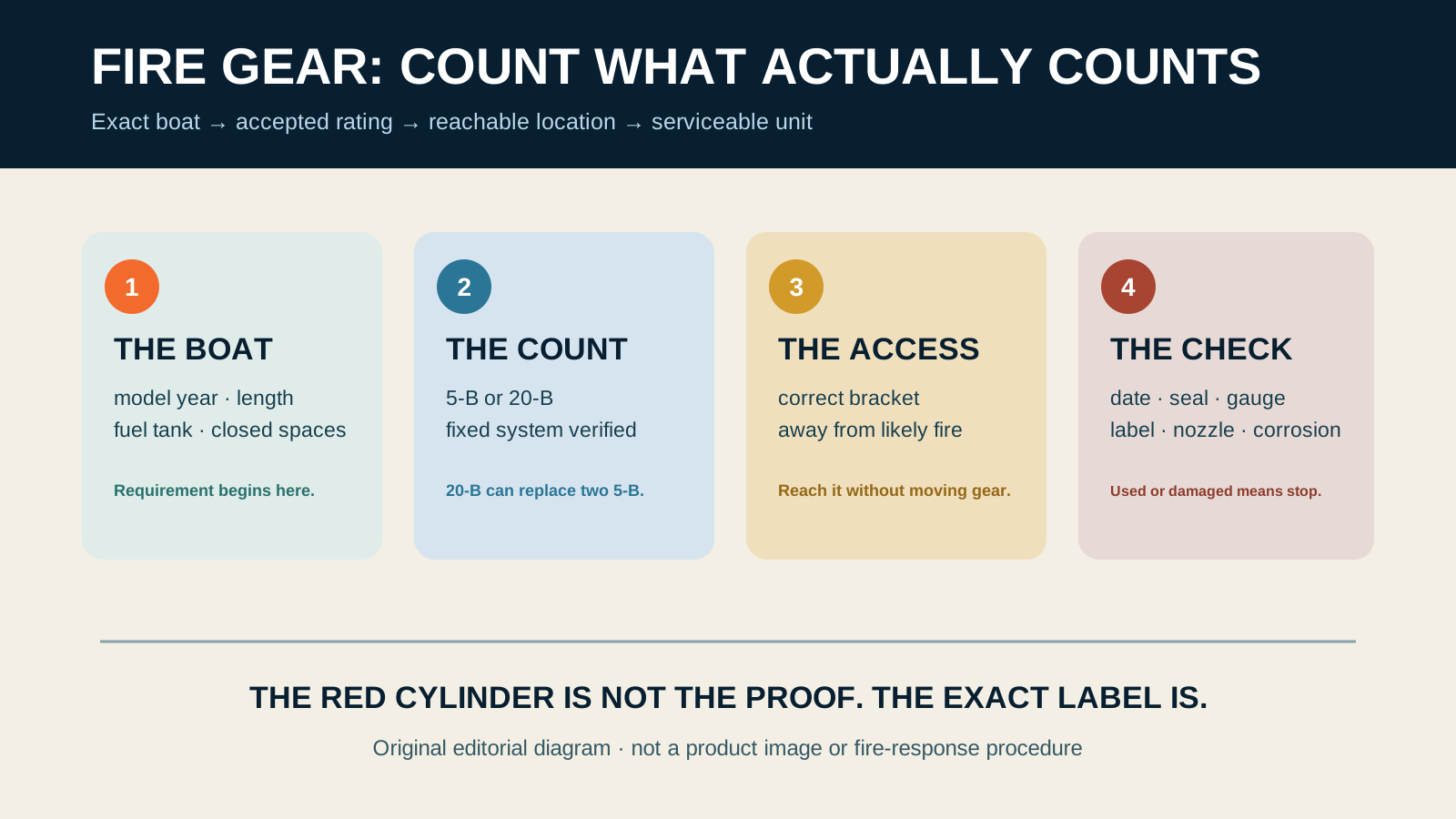
First decide whether the boat is required to carry one
The Coast Guard's current recreational-boater FAQ says carriage is required for boats with permanently installed fuel tanks or spaces capable of trapping fumes, including certain closed compartments, double bottoms, closed living spaces and storage compartments holding combustible or flammable material. A narrow exemption applies to some boats under 26 feet with an outboard, portable fuel tank and no vapor-trapping spaces. Do not turn that exception into a rule for every small outboard.
Inspect the actual vessel and its documentation. A deck plate that hides a permanent tank, a closed seat base used for portable fuel or a cabin can change the answer. State requirements and operating rules can be more protective than the federal minimum. When the layout is unclear, use the Coast Guard's current fire-extinguisher FAQ and request a vessel-safety check rather than relying on a retailer's boat-length filter.
The legal minimum is also not a complete fire plan. Cooking fuel, battery installations, shore power and machinery spaces create different hazards. Boat and equipment manuals, applicable standards and a qualified marine technician control installation and system-specific protection.
Count by model year, length and fixed system
For model-year 2018 and newer recreational boats that must carry portable extinguishers, the Coast Guard table uses date-stamped 5-B and 20-B units. Boats from model years 1953 through 2017 may use the older B-I/B-II system when the units remain permitted and serviceable, or current 5-B/20-B units within the applicable age rule. This is why advice that says only “carry a B-I” can be wrong for a newer boat.
| Boat length | No fixed machinery-space system | With qualifying fixed system |
|---|---|---|
| Under 16 feet | One 5-B | Zero portable |
| 16 to under 26 feet | One 5-B | Zero portable |
| 26 to under 40 feet | Two 5-B | One 5-B |
| 40 through 65 feet | Three 5-B | Two 5-B |
One approved 20-B may substitute for two required 5-B extinguishers. A 10-B counts only as one 5-B; its number does not make it a two-for-one substitute. A fixed system reduces the portable count only when it qualifies for the table. Do not assume that an unverified automatic bottle in an engine compartment earns the reduction.
Read the delivered label, not the listing
The Coast Guard says the bottle label should identify it as Marine Type – USCG Approved. Confirm that language, the 5-B or 20-B rating, manufacture or date stamp, model number and instructions on the physical extinguisher that arrives. Marketplace titles combine variants, and a photograph can show a different rating or bracket than the selected option.
Reject a unit with shipping damage, a missing pin or tamper seal, a gauge outside the operable range when a gauge is present, corrosion, a blocked nozzle, an unreadable label or evidence of discharge. Some disposable extinguishers are replaced rather than recharged; serviceable rechargeable units need work by a qualified fire-equipment provider according to the manufacturer. Never refill, weigh, hydrotest or alter a cylinder by improvisation.
USCG-approved 5-B marine extinguisher
Verify the exact label, date stamp, bracket compatibility and whether the delivered model satisfies this boat's count.
Check current priceUSCG-approved 20-B marine extinguisher
A qualifying 20-B can replace two 5-B units, but larger size and weight must still fit a reachable location.
Check current pricePut access ahead of symmetry
Portable extinguishers must be readily accessible. The Coast Guard strongly recommends mounting, although the federal FAQ does not make mounting universal. A loose cylinder can roll, corrode, disappear beneath gear or become a projectile. Use the bracket specified for the exact extinguisher and mount it according to both the extinguisher and boat manufacturer's instructions.
Do not place the only extinguisher where the likely fire blocks access. A unit deep inside an engine compartment, beside the stove flame or behind the battery switch may be unreachable. Do not drill until structure, wiring, plumbing, fuel spaces and required clearances have been identified. On boats needing multiple units, separated accessible positions can make more sense than a neat row in one locker.
Inspect monthly and record the date
Before the season and monthly while in service, verify that the correct required units remain aboard, accessible and undamaged. Read the manufacturer procedure. Typical checks include the pin and tamper seal, gauge position where fitted, nozzle, hose, bracket, corrosion and evidence of leakage or previous use. The Coast Guard FAQ says required units must not be expired or appear previously used.
Age rules matter. The current federal guidance says portable 5-B and 20-B extinguishers with a date stamp must be no more than 12 years old when carried to meet the rule. Older model-year boats may have additional B-I/B-II allowances, but “it still looks full” is not proof of compliance. Record each unit's location, model, manufacture date and replacement or service date in the boat log.
After a discharge—even a short one—treat the extinguisher as used and follow the manufacturer service or replacement instructions. Do not put it back in the bracket because the gauge happens to look acceptable.
The fire response is not a shopping decision
A portable extinguisher can help with a small, incipient fire only when the operator has a clear escape, the correct agent, and conditions that do not expose the crew to fuel, smoke, explosion, energized equipment or loss of vessel control. If the fire is growing, the extinguishing agent is wrong or the exit is threatened, prioritize people, distress communication and abandonment preparation. Never open a hot machinery space casually; added air can intensify a fire.
Brief the crew before departure: engine stop and fuel or electrical shutoffs only when safely accessible, extinguisher locations, VHF and emergency calls, wearable life jackets, and the route away from the fire. The site's boat fire response guide, ventilation guide and predeparture checklist cover the larger system. A portable extinguisher is one layer, not permission to fight every fire.
Fuel, propane, lithium battery, shore-power and engine-space hazards require system-specific procedures. Consult a qualified marine technician or fire-protection professional when the boat's design, fixed system or charging installation is outside the owner manual.
What not to buy
- A red cylinder whose listing says marine but whose exact delivered label does not show Coast Guard approval.
- A 10-B unit purchased as a two-for-one replacement for two required 5-B extinguishers.
- An extinguisher too large or heavy for the crew to release and control.
- A generic bracket that does not match the extinguisher model or marine installation instructions.
- A used cylinder with unknown age, discharge, corrosion or service history.
- An automotive or household unit selected without proving its approval and suitability for the vessel.
- A second extinguisher placed beside the first when separation would preserve access.
Skip the purchase until the rule is understood. Buying three wrong units creates more clutter, not more protection. The correct order is vessel inventory, required count, exact approved rating, accessible installation, crew briefing and documented inspection.
The ten-minute prelaunch audit
Do this audit after the boat is packed. A legal extinguisher buried under dock lines is no longer a useful answer. If any part is uncertain, stop at the inspection stage and use a vessel-safety examiner or qualified provider.
Frequently asked questions
Does every motorboat need a fire extinguisher?
No. The requirement depends on features such as a permanently installed fuel tank and spaces that can trap vapors. A limited exemption can apply to some boats under 26 feet with an outboard, portable tank and no vapor-trapping spaces.
Does one 10-B extinguisher replace two 5-B extinguishers?
No. Current Coast Guard guidance says one approved 20-B may replace two 5-B units, while a 10-B counts only as one 5-B.
Must a boat fire extinguisher be mounted?
The Coast Guard strongly recommends mounting, and some labels require use with the supplied bracket, but the federal FAQ does not make mounting universal. Every required portable unit must be readily accessible and installed according to its label and the boat instructions.
How old can a boat fire extinguisher be?
Current federal guidance generally limits date-stamped portable 5-B and 20-B units used for compliance to 12 years. Older B-I/B-II allowances depend on boat model year and serviceable condition. Verify the current rule and exact date stamp.
Can I keep an expired extinguisher aboard as a spare?
The Coast Guard FAQ says an old unit may remain aboard, but it does not count toward the required compliant equipment. It must not obstruct or be confused with the current readily accessible units.